Table Tennis Rally Analysis: Track Rally Length with DataTT【DataTT】
When you review a table tennis match, the final score alone rarely shows how long each point lasted.
Two matches that both finish 11-8 can feel completely different. One may be decided mostly on the serve. Another may turn on long exchanges.
With DataTT, you can record the number of shots in each point along with the score. After the match, you can review average rally length, the longest rally, and point results by rally length.
If you want a refresher on scoring basics first, see Table Tennis Scoring Rules.
What Rally Length Reveals in Table Tennis
In table tennis, the same 11-8 score can hide very different point patterns.
For example:
- points decided on the serve
- points decided on the receive
- points decided with a third-ball attack
- points decided after a longer rally
each tell a different story about the match.
DataTT lets you record rally length for every point as you keep score.
With that data, you can review whether the match stayed short, whether rallies stretched out, and which rally lengths favored you—using numbers instead of memory alone.
If you also want to track how points ended and which shots were involved, see how to record point outcomes.
How Rally Length Is Counted
In DataTT, the serve counts as the first shot.
The basic idea is:
- decided on the serve → 1 shot
- decided on the receive → 2 shots
- decided on the third ball → 3 shots
- decided on the fourth ball → 4 shots
- longer points use the actual number of shots
For example:
serve → receive → third-ball attack wins the point
that point is recorded as 3 shots.
When rally recording is on, you adjust the count on the score entry screen with − and +. Valid values range from 1 to 99, and the default is 3.
If you also record point outcomes and shot types, DataTT may auto-correct the rally count based on the selected shot. For example, an untouched serve becomes 1 shot, a receive becomes 2 shots, and other shots are adjusted to at least 3. In simple score entry, the number you set manually is used as is.
You can turn rally recording on or off only while no points have been recorded yet.
Check Average and Longest Rally
From the points you record, DataTT automatically calculates:
- Average Rally Count
- Longest Rally
Average rally count is the sum of recorded shot counts divided by the number of valid points. It helps you see whether the match was mostly short or full of longer exchanges.
Longest rally shows the highest shot count in the selected range.
On the stats screen, you can review the same summary for the whole match or filter by game (1G, 2G, and so on).
Analyze Point Results by Rally Length
DataTT groups points into these rally lengths:
- 1 shot
- 2 shots
- 3 shots
- 4 shots
- 5+ shots
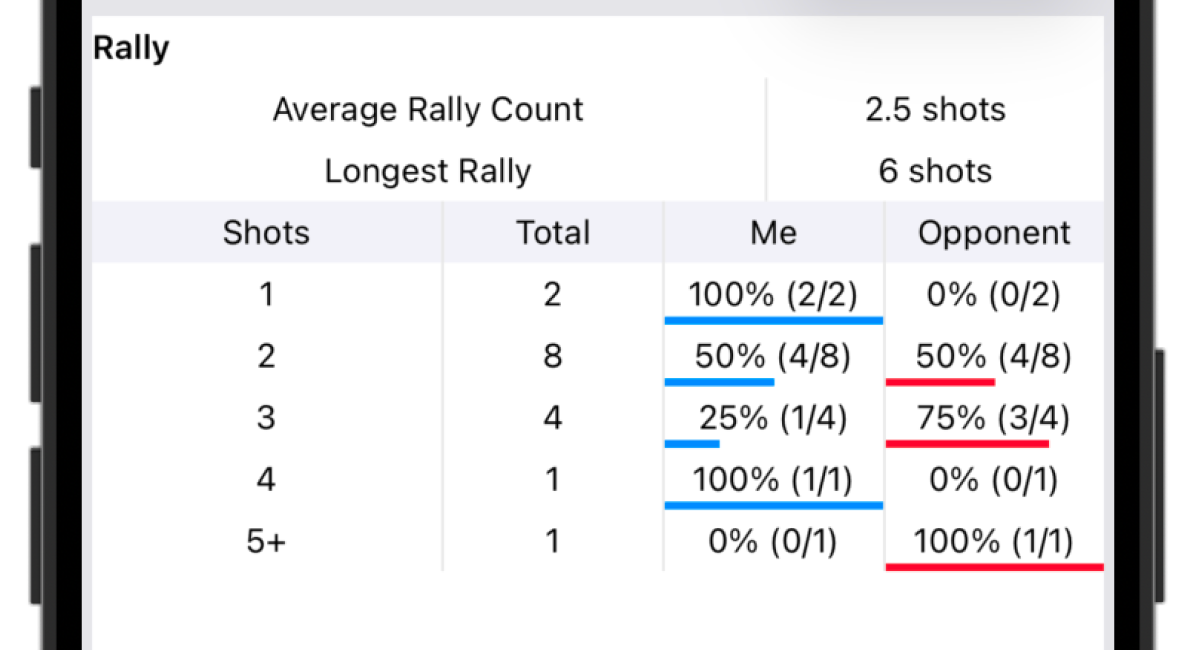
Review your average and longest rally, along with point results by rally length.
For each group, you can see the total number of points and how many Me and Opponent won, shown as both a percentage and a fraction.
In the example above:
- Average Rally Count: 2.5 shots
- Longest Rally: 6 shots
- 1 shot: Me 100% (2/2)
- 2 shots: 50% (4/8) vs 50% (4/8)
- 3 shots: Me 25%, Opponent 75%
- 4 shots: Me 100%
- 5+ shots: Opponent 100%
That does not mean longer rallies are always a weakness.
A better takeaway is: “In this match, the opponent won the 5+ shot point,” or “This is useful material for reviewing short vs long exchanges.”
What 1-Shot and 2-Shot Points Show
A 1-shot point ends on the serve. A 2-shot point ends by the receive.
Together, they help you review the earliest stage of each rally.
They are one way to see how often serve and receive are deciding points.
What 3-Shot and 4-Shot Points Show
Points that end on the third or fourth ball are useful for reviewing how attacks are built.
They can prompt reflection on:
- third-ball attack
- fourth-ball development
- patterns starting from the serve
- patterns starting from the receive
Looking at 5+ Shot Rallies
The 5+ group covers points that go beyond short exchanges.
If you lose more of these longer points, it can be a cue to review:
- consistency
- blocking
- placement
- errors during extended rallies
If your win rate is high, longer exchanges may be a strength in that match.
Do Not Judge From One Match Alone
Rally length changes with the opponent and the flow of the match.
Avoid locking in a style conclusion from a single match. Record several matches and look for patterns over time.
Review What the Score Alone Cannot Show
In table tennis, it is not only about how many points you scored. It also matters how many shots it took to win or lose each point.
Recording rally length lets you review average point length and where points fell across 1, 2, 3, 4, and 5+ shots.
Use rally data to analyze the match content the score alone cannot show.
Record and Analyze Rally Length with DataTT
DataTT lets you record the number of shots in each point along with the score. After the match, review average rally count, longest rally, and point trends by rally length.
[See all DataTT features](/table-tennis/en/)